
Why a single expired PSW certificate can mean a lost client contract and how automated credential tracking software protects your agency’s revenue.
For three years, I have run every system inside a live, licensed PSW agency in St. Thomas, Ontario. That includes recruitment, scheduling, payroll, and—most critically—credential tracking. I have seen exactly what happens when a PSW certification expires without anyone noticing.
The client calls. They ask for proof that your PSW is compliant. You scramble through folders, emails, and spreadsheets. You cannot find the updated certificate in time. The client books with another agency.
This is not a hypothetical. This happens every day in Ontario’s private PSW market. And in 2026, the stakes are higher than ever. With HSCPOA registration becoming a de facto standard and private agency rates running $30–$45 per hour, your clients have options. They will choose the agency that can prove compliance instantly. Automated credential tracking software is not a luxury—it is how you keep your clients and your revenue.
The Problem Explained: What Expired Credentials Actually Cost You
The "before state" for most PSW agencies is chaos. I know this because I lived it. Before we implemented a connected system at Essential Staff, we tracked credentials in a single spreadsheet. It listed PSW Certificate expiry dates, Police Vulnerable Sector Check dates, CPR & First Aid renewal dates, TB Test results, and References.
It was a disaster.
We had over 600 applicants in our database. Every week, someone would call asking about their application status. We would open the spreadsheet, scroll endlessly, and often find that their key credential had expired months ago. That PSW could not work. All that recruitment effort—wasted.
Worse, we missed expirations. A PSW would work a shift, and we would only discover their certificate had lapsed when we needed to invoice the client. The client would refuse to pay because their contract required fully compliant staff. We lost thousands of dollars in revenue. The client questioned our reliability.
Here is the specific detail only an agency operator would know: when a PSW's credential expires, it is not just an admin problem—it is a revenue problem. Your private clients are paying $30–$45 per hour for your service. If you cannot prove your staff are compliant, they will find another agency. It takes one expired certificate to lose a contract.
Why This Matters Right Now in 2026
The regulatory environment for PSWs in Ontario has shifted dramatically. Manual tracking is no longer sufficient. You need a system that gives you real-time visibility into every credential.
HSCPOA registration is a key factor. As of 2026, employers are increasingly making HSCPOA registration mandatory, even though it remains voluntary under provincial law . The HSCPOA Public Register allows anyone—including your clients—to verify a PSW's registration status instantly . If your PSW is not registered or their registration expires, it is public information.
HSCPOA annual renewals are due by March 31st each year, with the renewal portal opening February 1st . If you are not tracking this deadline for every PSW, you risk them becoming "inactive" on the public register. That is a risk your competitors will exploit.
The permanent $3/hour PSW wage enhancement and the $17.95 minimum wage effective October 1, 2026, are also making payroll compliance more complex. But the underlying issue is simple: your agency’s reputation and revenue depend on your ability to prove your PSWs are fully compliant. In 2026, manual tracking is a liability.
The Solution: Automated Credential Tracking as Part of a Connected System
The solution is not a better spreadsheet. It is an automated credential tracking system that is part of a fully connected operating system. At Essential Staff, we use the system we implement—built on Odoo 19 Enterprise—to track every credential for every PSW. The system does the work, so we can focus on our clients.
Here is how it works in a live agency. When a new PSW is hired, their credentials are entered into the system. We track PSW Certificate, Police Vulnerable Sector Check, CPR & First Aid, TB Test, and References. The system automatically sends alerts at 30, 14, and 7 days before any credential expires. No one has to remember. No one has to manually check a spreadsheet.
Our compliance dashboard is colour-coded: green for valid, yellow for warning, and red for expired. A single screen gives us a complete picture of our entire workforce. When we need to schedule an open shift, we only call PSWs who are "green"—fully compliant. The system automatically moves applicants with expired credentials to an "Expired Documents" stage in the recruitment pipeline.
This is the core of the system we implement. It connects recruitment, credential tracking, scheduling, payroll, and billing into one pipeline. When a PSW’s credential expires, the system prevents them from being scheduled. That means we never send a non-compliant PSW to a client. We never lose a client because we cannot prove compliance.
Here is what the transition looks like in practice.
Process | Manual (Spreadsheets) | Connected System with Automated Tracking |
Credential Expiry Monitoring | Manually check a spreadsheet weekly. | Automated alerts at 30, 14, and 7 days before expiry. |
Scheduling Compliance | Risk of scheduling a PSW with expired credentials. | System blocks scheduling of non-compliant PSWs. |
Client Proof of Compliance | Scramble to find paper certificates. | One-click access to digital records and public register. |
Recruitment Pipeline | Expired credentials lead to lost applicants. | Auto-moves expired applicants to "Expired Documents" stage. |
Revenue Protection | Lost revenue from non-compliant PSW claims. | Full compliance ensures all billable hours are approved. |
💡 Insider Tip: Do not just track expiry dates—track the verification process. With reports of sophisticated fake credentials in the PSW sector , you need to verify every certificate against the issuing body. Your system should not just record a date; it should record who verified the document and when.
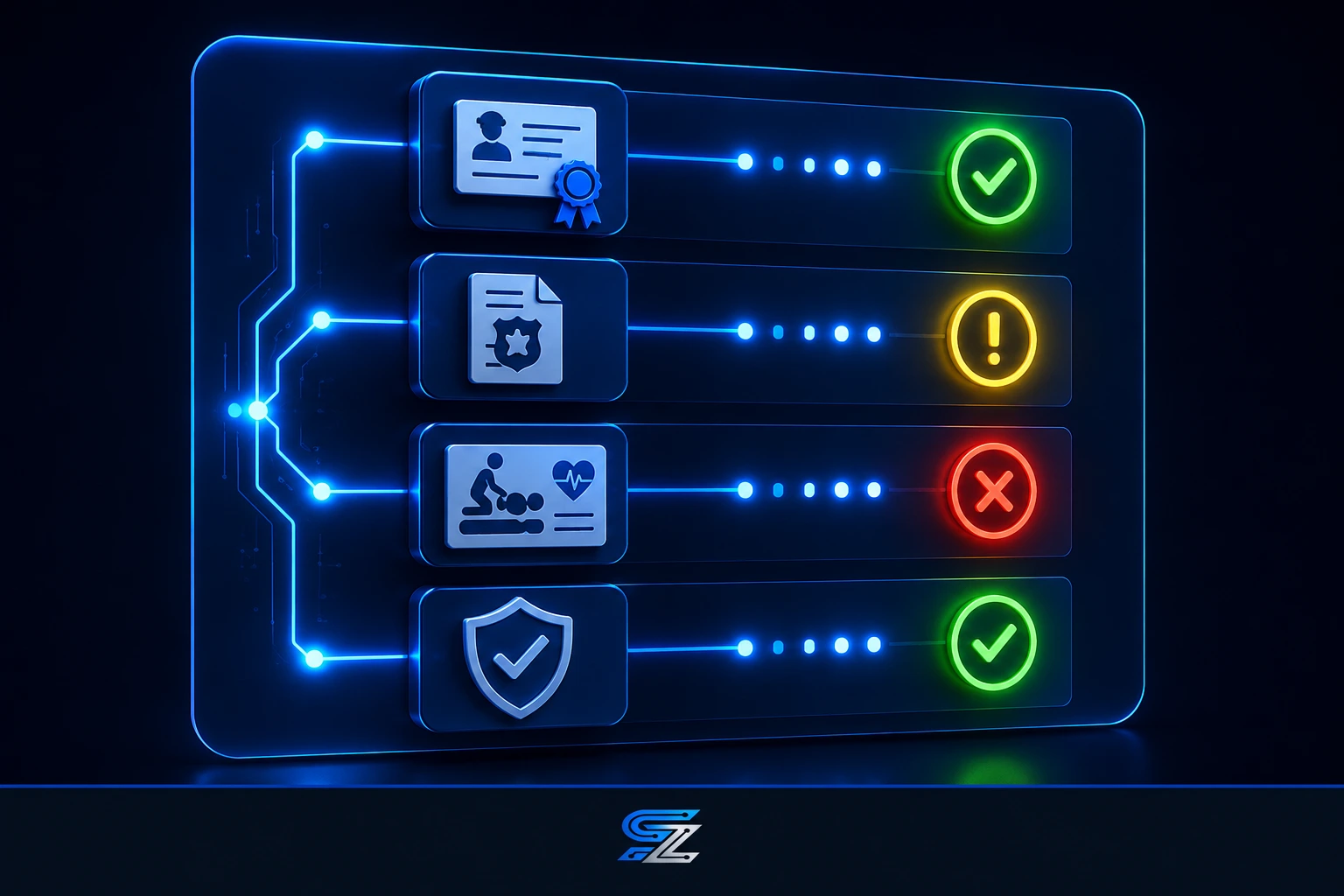
Pipeline/Process Breakdown: How Credential Tracking Protects Your Revenue
Credential tracking is not a standalone task. It is a core function of your entire operational pipeline. Here is how it flows from recruitment to payroll.
1. Staff Pipeline: From Applicant to Verified Employee
A PSW applicant submits their resume through your website. The application auto-lands in your recruitment database. The recruiter screens the applicant and requests all required credentials: PSW Certificate, Police Vulnerable Sector Check, CPR & First Aid, TB Test, and References. Instead of filing these papers away, the recruiter scans or enters the credentials and their expiry dates directly into the system. The applicant's record now contains their full compliance profile.
2. Compliance Monitoring: Automated Alerts and Dashboard
The system takes over from here. It calculates the days until each credential expires and sends automated email alerts to the designated compliance manager at 30, 14, and 7 days. The system also updates the colour-coded compliance dashboard in real-time. A manager can open the dashboard at any time and instantly see which PSWs are compliant, which are about to expire, and which are expired.
3. Scheduling: Credential-Gated Shift Allocation
This is where the system pays for itself. When a scheduler needs to fill an open shift, they only see PSWs who are "green"—fully compliant. The system prevents them from accidentally selecting a PSW with an expired credential. This eliminates the risk of sending a non-compliant PSW to a client, which protects your client relationships and your revenue.
4. Client Billing: Proof of Compliance Is Built In
When a PSW completes a shift and the timesheet is approved, the system automatically generates the client invoice. If a client ever questions compliance, you have a complete digital record of all credentials and their verification dates. You can provide proof of compliance instantly, ensuring the invoice is paid. This closes the loop from application to payment.
Real Results From a Live Ontario Agency
Essential Staff is a live, licensed PSW agency in St. Thomas, Ontario. The system I am describing is not a theory—it is how we run our business every day. The results are proof of what automated credential tracking can do for your agency.
We track over 600 applicants and active PSWs in our recruitment database. That number has grown from a baseline of 187 because we can now manage the volume. We do not lose applicants because their credentials expire unnoticed. The system automatically moves them to an "Expired Documents" stage, where they can be re-engaged when they renew.
Our compliance dashboard is our single source of truth. We can see the status of every PSW credential at a glance. This is not just about avoiding lost revenue; it is about building a reputation for reliability. Our clients know we have a system that ensures compliance.
The financial impact is undeniable. In three years, we have had zero CRA penalties. We have never lost a client because we could not prove a PSW's compliance. Our payroll process—which includes verifying credentials before paying a PSW—has gone from over three hours to just 18 minutes for 26 biweekly payroll runs per year. We process payroll faster because the data is clean and compliant.

Step-by-Step — How to Get Started
You can start improving your credential tracking today, even before you implement a full connected system. These steps will build the foundation for automated tracking.
Audit Your Current Credential Collection Process: Identify every type of credential you track. This is likely PSW Certificate, Police Vulnerable Sector Check, CPR & First Aid, TB Test, and References. Note where each document is stored. Do you have them in a file cabinet? In an email folder? In a spreadsheet? Knowing where your data lives is the first step to centralizing it.
Centralize Your Credential Data: Move all credential data into a single, searchable digital file or database. A well-structured spreadsheet is better than multiple file folders. The goal is to have one record per PSW that lists every credential and its expiry date. This is not a long-term solution, but it is a necessary first step.
Create a Manual Alert Calendar: For the next 30 days, manually add a recurring task to your calendar to check expirations. Set aside 15 minutes every Monday morning to review the expiry dates for the next 30 days. Start calling or emailing PSWs to remind them to renew. This builds the discipline needed for automated alerts.
Establish a Policy for Credential Verification: Decide who in your agency is responsible for verifying each credential. The document should be checked against the issuing body's records. Document this verification process. This becomes the standard operating procedure that will be automated later.
Track a Single Credential End-to-End: For one new PSW, track their PSW Certificate from collection through verification to expiry. Use your new manual process. This is a dry run. Note every step, every challenge, and every time you are tempted to skip a step. This exercise will show you exactly what your future system needs to do.
Common Mistakes to Avoid
Switching to automated credential tracking is a significant improvement, but it is also easy to make mistakes. Here are the most common pitfalls.
Treating Credential Tracking as an HR Problem, Not a Revenue Problem
Many agency owners treat credential tracking as an administrative burden. It is not. It is a revenue protection function. If you are not tracking credentials, you are taking a needless risk. One expired credential can cost you a client contract worth thousands of dollars per month. This is a core business function, not a back-office chore.
Tracking the Date But Not the Verification Status
A certificate expiry date is meaningless if you have not verified the certificate is authentic. With the rise of credential fraud, you must verify every certificate with the issuing body. Your system should allow you to record who verified the document and when . This is the only way to build an audit trail.
Ignoring the Public Register
HSCPOA has a Public Register of registered PSWs . If you are not checking this register before hiring or scheduling a PSW, you are missing a key compliance step. Your system should allow you to log this check. An automated system can even integrate with the register via an API.
Not Having a Process for "Grandparented" PSWs
The HSCPOA legacy pathway for PSWs who completed their education before July 1, 2014, or who have significant work experience, closes on December 1, 2027 . You must know which of your PSWs are on this pathway and track their progress. If they miss this deadline, they may need to go back to school to qualify .
Forgetting That Renewal Is Ongoing
HSCPOA registration requires annual renewal by March 31st each year . This is not a one-time event. Your system must track this annual deadline for every registered PSW. An automated system that sends renewal reminders is the only reliable way to manage this.
Protect Your Clients and Your Revenue
Credential tracking is not a nice-to-have in 2026. It is a competitive necessity. Your clients have choices. They can hire an agency with a connected system that proves compliance instantly. Or they can hire an agency that scrambles to find paper files. The choice is obvious.
The system we implement at SYNERZ is built for this moment. It connects your recruitment, credential tracking, scheduling, and billing into one pipeline. It protects your revenue by ensuring you never send a non-compliant PSW to a client.
Book a free 20-minute credential tracking review. We will review your current process and give you a clear picture of where your agency stands. No pitch. No obligation. Just clarity.
📧 info@synerz.ca | 📞 +1 647 493 8110 | 🌐 www.synerz.ca
Frequently Asked Questions
Why is credential tracking important for a PSW agency?
Credential tracking is essential for protecting your revenue and reputation. If you cannot prove a PSW is compliant, you can lose client contracts. Automated credential tracking also prevents you from scheduling non-compliant PSWs, which is a critical risk management function.
What credentials should a PSW agency track?
A PSW agency must track the PSW Certificate, Police Vulnerable Sector Check, CPR & First Aid, TB Test, and References. Additionally, you should track HSCPOA registration status and annual renewal dates. These are the core credentials required for private PSW contracts.
What happens if a PSW's credential expires and they work a shift?
If a PSW works a shift with an expired credential, your client may refuse to pay the invoice. This is a direct revenue loss. It also damages your reputation and can lead to the client switching to another agency. This is why automated tracking is essential.
Do I need to track HSCPOA registration?
Yes. HSCPOA registration is becoming a de facto standard in Ontario. Many employers now require it, and your clients can check the Public Register to verify your PSWs' status. If your PSW is not registered or their registration expires, it is public information.
How can a connected system help with credential tracking?
A connected system automates the entire process. It tracks expiry dates, sends alerts at 30, 14, and 7 days, and blocks scheduling of non-compliant PSWs. It also generates an audit trail for every credential, proving to clients and regulators that you are fully compliant.
Author: Munawar Abbas — Founder & CEO, SYNERZ