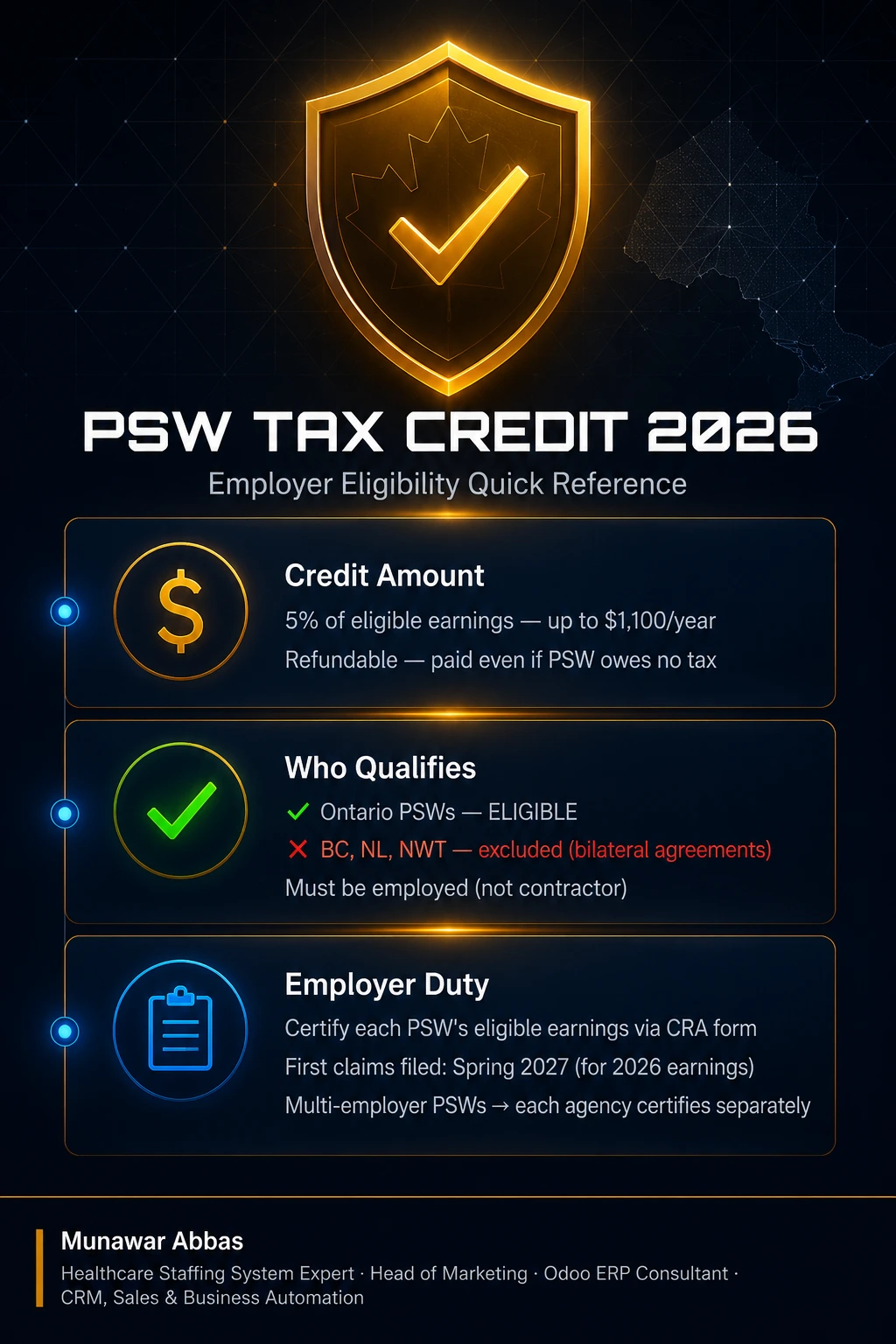
If you run a PSW agency in Ontario, the PSW tax credit 2026 is not a worker benefit you can ignore from the sidelines. It is now an employer obligation. Starting with the 2026 tax year, the Canada Revenue Agency expects you the employer to certify each worker's eligible earnings under the new personal support worker tax credit on a prescribed form. That is brand-new paperwork riding on top of every payroll run you already do.
Here is why this matters today: searches for "PSW tax credit 2026" are up more than 1,050% in Canada right now. Your workers are reading about a refundable $1,100 credit, and by tax season 2027 they will be asking you to prove their numbers.
Consider this your employer payroll guide to the credit I will show you exactly what it changes for your payroll system, what you must produce for the CRA, and how we built this into a live Ontario agency without adding a single hour of admin.
The PSW Tax Credit 2026 Creates a New Employer Problem
Let me be direct. The credit itself is good news for your staff. It is a temporary, refundable federal credit worth 5% of eligible earnings, up to $1,100 per year, running from the 2026 to 2030 tax years. So who is eligible for the PSW tax credit? A PSW earning $22,000 or more in eligible pay gets the full $1,100 even if they owe no tax.
The problem is who carries the recordkeeping. That is you.
To make the credit work, the CRA requires the employer to certify each worker's eligible earnings in a prescribed form. If a PSW has two jobs and in this sector, plenty do each employer must certify their portion separately. Your numbers and the other agency's numbers both land on the same worker's return.
Now picture your back office on the day this gets requested. Three years ago at Essential Staff, our PSW pay data lived in three places: a spreadsheet for hours, a separate file for wage enhancements, and a payroll provider's portal for the actual run. Pulling a clean per-worker earnings figure meant reconciling all three by hand.
We tracked 187 PSW staff. A manual payroll run took us more than three hours, every two weeks, 26 times a year. Adding a year-end certification step to that process was a recipe for errors.
And errors here are not minor. If your certified figure does not match what you remitted, you have a mismatch sitting in CRA's system against a worker's refund. Multiply that by 187 people and you understand the exposure.
This is the gap no payroll product was built for: a Canadian PSW staffing agency that now has to issue employer certifications for a brand-new credit, on top of CRA-compliant payroll it was already struggling to keep clean.
What the PSW Tax Credit 2026 Means for Employers Right Now
The timing is the part most owners miss. This is not a "next year" problem.
This tax credit in Canada for 2026 means eligible earnings accumulate across the entire calendar year. Workers file their first claims on 2026 returns in spring 2027 which means your numbers are being recorded today, in the payroll runs you are doing this month. There is no going back to clean up a year you did not track properly.
The PSW tax credit in Ontario lands on top of three more 2026 realities:
- Ontario minimum wage rises to $17.95/hour on October 1, 2026. Mid-year wage changes split your eligible-earnings calculation across two rates.
- The permanent $3/hour PSW and DSW wage enhancement continues for 2026-27 — and how you classify that pay affects the eligibility figure.
- HSCPOA registration is live, with the first renewal deadline of March 31, 2026. Only about 6,100 of Ontario's 100,000-plus PSWs had registered as of late 2025.
There is also a quieter pressure. CRA worker-misclassification enforcement is active in healthcare staffing this year, and the "Payments to workers of placement and employment agencies" guidance was updated April 20, 2026. If you treat PSWs as contractors to dodge source deductions, you have just disqualified them from the credit and put yourself in the enforcement cross hairs. Clean employee payroll is now a competitive advantage, not just a compliance chore.
The Payroll Fix: Certifying Eligible Earnings Without the Chaos
So how do you actually produce a defensible, per-worker eligible-earnings figure without burning a weekend on it? You stop running payroll across disconnected tools and run it inside one system that already knows every dollar you paid each PSW.
That is what we built at Essential Staff using Odoo 19 Enterprise. Odoo payroll in Canada handles CPP, CPP2, EI, and provincial tax natively, and we now implement it for other Ontario agencies. The point is not "buy software." The point is that the credit data gross pay, wage enhancement, taxable benefits is the same data your payroll already holds. If it lives in one place, certification is a report, not a project.
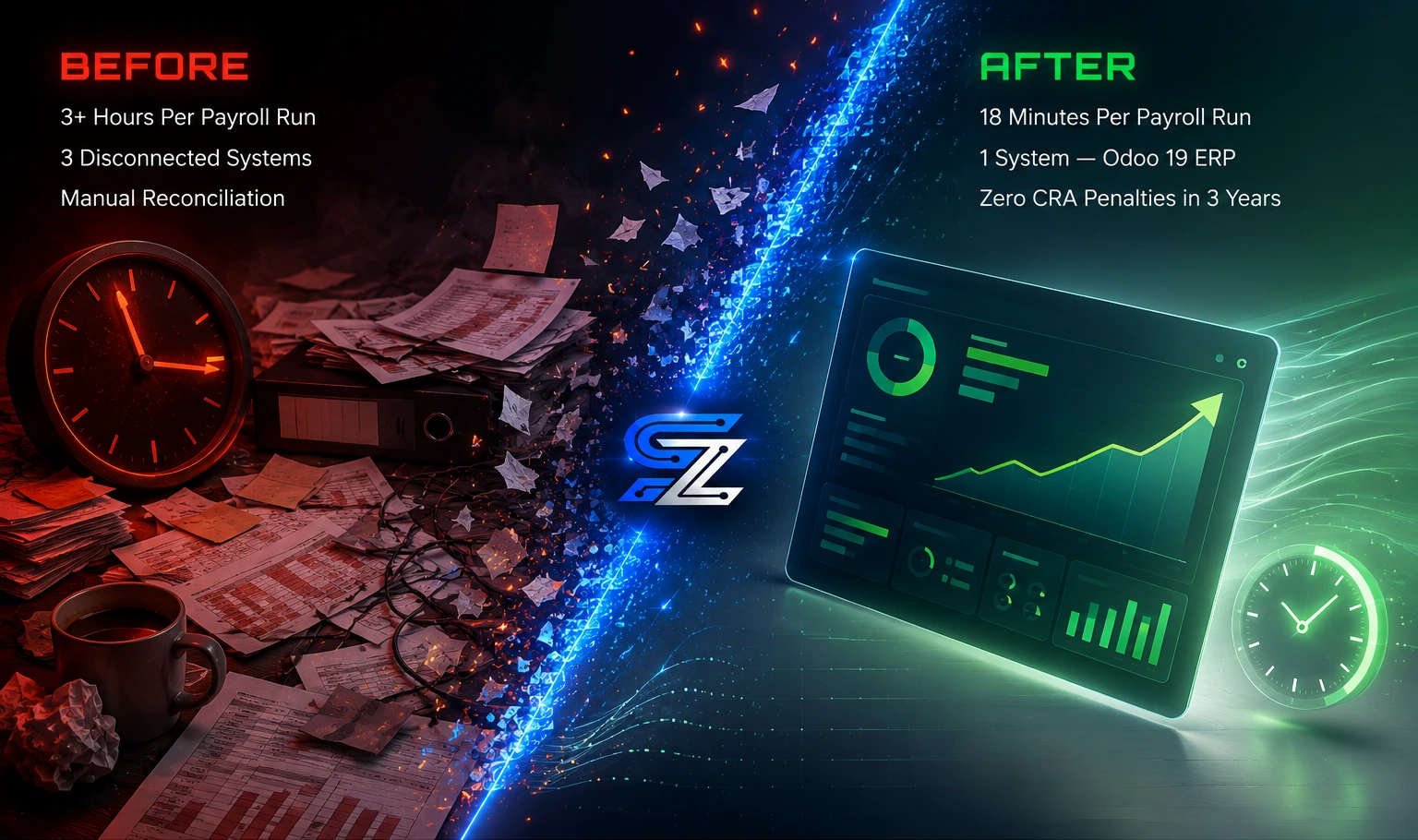
Here is the before-and-after, using our real numbers.
| Payroll task | Before (spreadsheets + portal) | After (Odoo 19 ERP) |
|---|---|---|
| Time per biweekly payroll run | 3+ hours | 18 minutes |
| Per-worker eligible-earnings figure | Manual reconciliation, 3 sources | One report, one click |
| CRA penalties in 3 years | Risk on every run | Zero |
| Credentials tracked | Scattered files | 187, colour-coded dashboard |
| Year-end employer certification | Did not exist / manual nightmare | Pulled from existing payroll data |
The mechanics inside a PSW agency look like this. Approved timesheets flow into payroll automatically. CPP, CPP2, EI, federal and Ontario tax are calculated on every run for 2026 that means the CPP YMPE of $74,600, the CPP2 4% band on earnings between $74,600 and $85,000, and the EI rate of 1.63% on insurable earnings up to the $68,900 maximum.
Because every payroll line is already structured, year-end eligible earnings per PSW is a filter, not a recount. When CRA's certification form is finalized, you populate it from data you already validated 26 times that year.
That is also why our credential side stays clean: 187 PSW credentials PSW Certificate, Police Vulnerable Sector Check, CPR & First Aid, TB Test, References tracked on one dashboard with automated alerts at 30, 14, and 7 days before expiry. Eligible workers need to be genuinely employed and credentialed, and the same system proves both.
💡 Insider Tip: Start tagging PSW eligible earnings as a distinct payroll category now, mid-2026 not in 2027.. If you wait until certification season, you will be hand-sorting a full year of pay lines to separate eligible PSW work from admin or non-care hours. Tag it at the source and the year-end figure builds itself.
Need help getting your payroll ready to certify the PSW tax credit 2026? See how SYNERZ builds this for Canadian PSW agencies → www.synerz.caReal Results From a Live Ontario Agency
I do not sell theory. Essential Staff is a licensed PSW agency in St. Thomas, Ontario, and I ran every system inside it for three years before packaging it.
Here is what the numbers look like in practice.
We took our biweekly payroll from 3+ hours down to 18 minutes. Across 26 runs a year, that is roughly 65 hours of admin reclaimed annually time that now goes into filling shifts instead of fixing spreadsheets.
In three years of operation, we have had zero CRA penalties. Not one source-deduction correction, not one remittance flag. When you run CRA-compliant payroll inside one system, the 90% remittance threshold and your deduction math stop being guesswork.
On the operations side, our open-shift alert system notifies all 187 PSWs in our applicant pool by email blast in under three minutes. Before, filling an overnight cancellation meant phoning down a list. Now the right qualified, credentialed staff hear about it instantly.
Our compliance dashboard is colour-coded green for valid, yellow for warning, red for expired so an audit-readiness check that used to take an afternoon now takes one glance. Applicants whose credentials lapse are auto-moved to an "Expired Documents" stage so they never get alerted for a shift they cannot legally take.
This is the proof a generic payroll vendor cannot show you. They were built for clinics and hospitals. We were built inside a working Ontario PSW agency, which is exactly why the PSW tax credit 2026 employer certification fits the system instead of breaking it.
How Ontario PSW Agencies Can Prepare for the Tax Credit 2026
You can start preparing today, with or without us. Here is the order I would follow:
- Confirm your province qualifies. Ontario PSWs are eligible. Workers in British Columbia, Newfoundland and Labrador, and the Northwest Territories are excluded because of separate wage agreements relevant if you operate across borders.
- Verify your PSWs are true employees, not contractors. Only paid employment income at an eligible health care establishment counts. Misclassified workers lose the credit and expose you to CRA review.
- Separate eligible PSW pay from everything else. Tag care-delivery hours distinctly from admin, training, or travel pay so the eligible figure is clean.
- Reconcile your wage enhancement and minimum-wage changes. Account for the $3/hour enhancement and the October 1, 2026 jump to $17.95/hour within the same earnings record.
- Pick a single source of truth for payroll. Whatever system you choose, your certified figures must match your T4s and remittances exactly.
- Talk to your accountant before filing season. Confirm how the certification form applies to your specific payroll setup.
Common PSW Tax Credit 2026 Mistakes Employers Make
I see the same avoidable errors across agencies. Do not repeat them.
Mistake 1: Treating it as the worker's problem. It is not. The certification burden is yours, and a worker denied their refund because of a missing or wrong employer figure will not stay quiet about it.
Mistake 2: Tracking eligible earnings only at year-end. By December you cannot reconstruct which hours were eligible PSW care versus office time. Tag it as you pay it.
Mistake 3: Misclassifying PSWs as contractors. It disqualifies the credit, breaks source-deduction rules, and lands you squarely in 2026's misclassification enforcement.
Mistake 4: Running payroll across disconnected tools. When hours, enhancements, and remittances live in three systems, your certified figure and your remitted figure drift apart and CRA notices the gap.
Book a Free 20-Minute Compliance Check
You do not have to figure the PSW tax credit 2026 employer certification out alone. Book a free 20-minute compliance check and we will review your current payroll and credential setup and give you a clear picture of where your agency actually stands going into certification season. No pitch. No obligation. Just clarity from a fellow Ontario operator who has already done it.
📧 info@synerz.ca 📞 +1 647 493 8110 🌐 www.synerz.ca
This article is general information for agency owners, not tax or legal advice. Confirm credit figures and certification requirements with the CRA and your accountant.
Frequently Asked Questions
What is the PSW tax credit for 2026?
It is a temporary, refundable federal tax credit worth 5% of a personal support worker's eligible earnings, up to $1,100 per year, running for the 2026 to 2030 tax years. Because it is refundable, eligible PSWs receive it even if they owe no income tax.
Who is eligible for the PSW tax credit?
Personal support workers who earn employment income at an eligible health care establishment and provide hands-on care directed by a regulated health professional or health organization. Ontario qualifies; workers in BC, Newfoundland and Labrador, and the Northwest Territories are excluded due to separate wage agreements.
Is there a PSW tax credit for 2025?
No. The credit applies to the 2026 through 2030 tax years only. The first opportunity to claim it is on a 2026 tax return filed in spring 2027, which is why your 2026 payroll records matter now.
What payroll system do healthcare agencies use?
Many small agencies still rely on spreadsheets plus a basic payroll portal, which struggles with credential tracking and CRA certification. Agencies running on an integrated ERP like Odoo 19 keep payroll, compliance, and reporting in one place which is what makes new obligations like the PSW tax credit certification manageable.
What happens in a payroll inspection with CRA?
The CRA reviews whether your source deductions, remittances, and worker classifications match your records and filings. Clean, single-source payroll data with employee status and remittances reconciled is the difference between a quick review and a costly correction.
Author voice: Munawar Abbas - Founder & CEO, SYNERZ