
Many PSW agency owners assume home care is automatically GST/HST-exempt. That assumption can cost you thousands in uncollected tax, penalties, and missed input tax credits.
If you run a PSW agency in Ontario, you have probably wondered about GST/HST.
Do you charge it? Are your services exempt? Do you need to register?
I have run the numbers for a live PSW agency in St. Thomas, Ontario for three years. I have dealt with CRA compliance, invoicing, and input tax credits. And I have learned that the rules are not what most agency owners assume.
Here is the short answer: A purely private-pay PSW agency with no government funding link is generally providing taxable services—not exempt ones. This was confirmed in CRA GST/HST Ruling 196193 (2023) and explained in CRA's interpretive guidance GI-166.
If you have been assuming your services are exempt and not charging GST/HST, you could be at risk of a CRA assessment for uncollected tax.
This blog walks you through what every PSW agency owner needs to know about GST/HST—and how a connected accounting system helps you stay compliant.
The Problem: The Most Common GST/HST Mistake PSW Agencies Make
The most common mistake PSW agency owners make is assuming all home care services are GST/HST-exempt.
Here is why that assumption is dangerous.
Under the Excise Tax Act Schedule V, Part II, section 13, a home care service is exempt only where there is a public-funding nexus. This means one of three conditions must be met:
The supplier is a government or municipality.
A government, municipality, or organization administering a government program pays an amount toward the supply.
The same individual is concurrently receiving a publicly funded home care service.
If none of these conditions apply—if you are a purely private-pay agency paid only by the client or family, with no government funding link—your services are generally taxable, not exempt.
The practical consequence is the opposite of the common assumption: many new private-pay home care agencies are required to register for GST/HST and charge tax once they pass the small-supplier threshold.
I have seen agencies get hit with a CRA assessment for uncollected GST/HST because they assumed their services were exempt. The assessment included the tax they should have charged, plus penalties and interest. It wiped out months of profit.
Why This Matters Right Now in 2026
The GST/HST rules for PSW agencies are not new, but they are frequently misunderstood. And the CRA is actively enforcing them.
First, the distinction between funded and private-pay services is critical. If you have a mix of funded (exempt) and private-pay (taxable) clients, you need to track which is which. You cannot assume everything is exempt.
Second, you must register for GST/HST if you exceed the small-supplier threshold. The threshold is $30,000 in taxable supplies over four consecutive calendar quarters. If you pass this threshold and you are providing taxable services, you must register and start charging tax.
Third, input tax credits (ITCs) matter. If you are registered for GST/HST, you can claim ITCs on the GST/HST you pay for business expenses. This includes things like office supplies, software, and equipment. If you are not registered, you cannot claim these credits. You are leaving money on the table.
Fourth, there is a compliance risk for independent contractors. If you hire PSWs as independent contractors and they are not charging GST/HST, there could be issues. A PSW who earns over $30,000 in self-employment income is required to register for GST/HST and charge it on their services. If they do not, they are non-compliant.
The bottom line: Understanding your GST/HST obligations is essential for protecting your agency from CRA penalties and maximizing your financial position.
The Solution: A Connected Accounting System That Handles GST/HST
The solution is a connected accounting system that tracks taxable and exempt supplies, generates compliant invoices, and helps you claim input tax credits.
At Essential Staff, we use the system we implement—built on Odoo 19 Enterprise—to manage GST/HST compliance, invoicing, and tax reporting in one connected flow.
Here is how the connected system changes GST/HST management:
Before (Manual Process) | After (Connected System) |
Agency owner guesses whether services are taxable or exempt. | The system tracks funded vs. private-pay clients and applies the correct tax treatment. |
Invoices are manually created without consistent GST/HST application. | The system auto-generates invoices with correct tax rates based on client type and service. |
Agency owner manually tracks whether they are below or above the $30,000 threshold. | The system tracks taxable supplies and alerts you when you are approaching the threshold. |
Agency owner manually tracks ITCs on expenses. | The system tracks GST/HST paid on expenses and reports ITCs automatically |
What the Connected System Does Differently
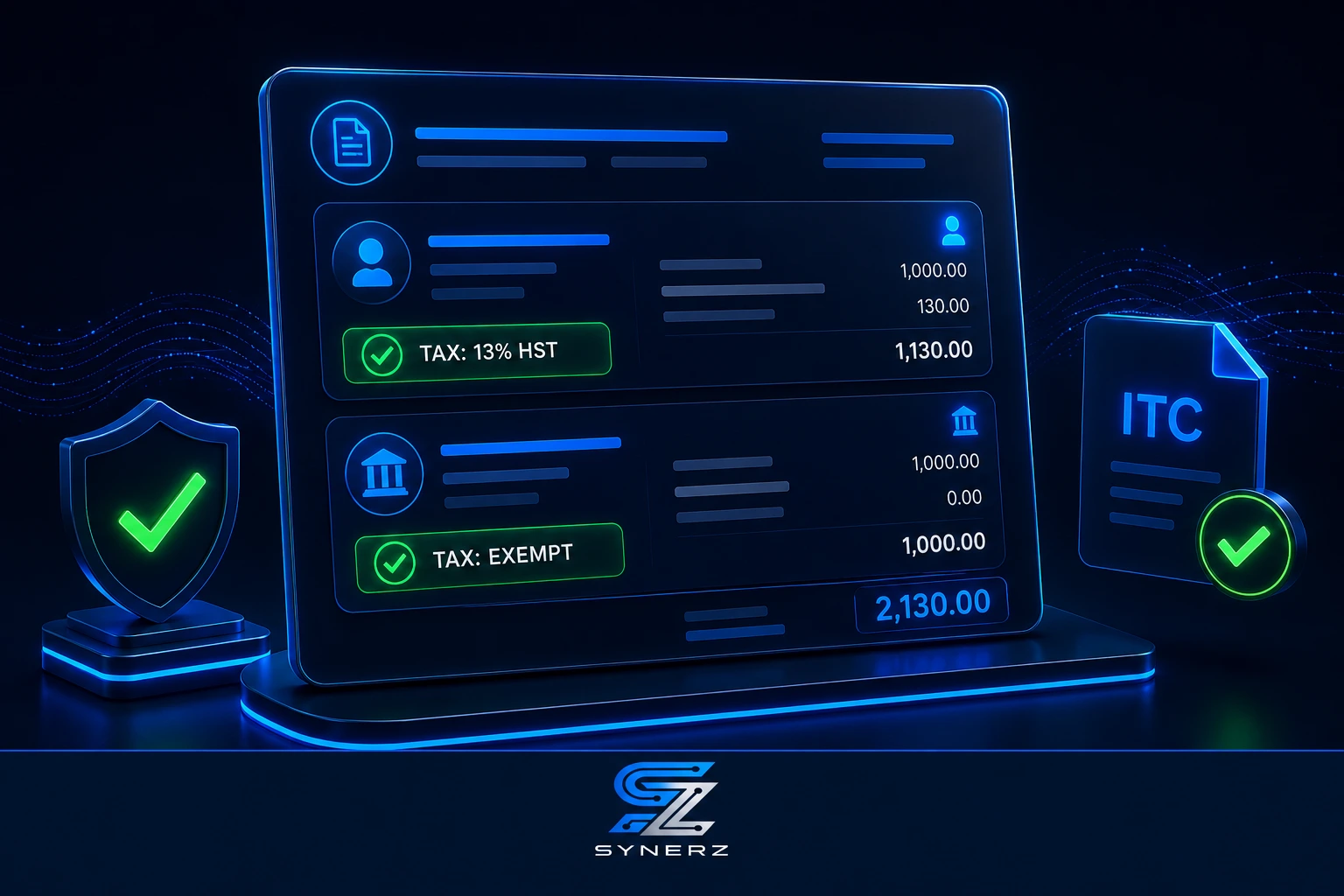
First, it tracks the funding nexus for each client. The system flags which clients are publicly funded (exempt) and which are private-pay (taxable). It applies the correct tax treatment to each invoice automatically.
Second, it generates compliant invoices. The system includes the correct GST/HST rate (5% GST, 13% HST in Ontario, or 15% HST in other participating provinces) on taxable supplies. It clearly identifies exempt supplies where applicable.
Third, it tracks the small-supplier threshold. The system monitors your taxable supplies over a rolling four-quarter period. It alerts you when you are approaching the $30,000 threshold so you can register on time.
Fourth, it tracks input tax credits. The system records GST/HST paid on business expenses. It reports these as ITCs on your GST/HST return, reducing the amount you owe.
Fifth, it handles mixed supplies. If you provide both funded (exempt) and private-pay (taxable) services, the system tracks both streams separately. It ensures the correct tax treatment for each invoice.
This is not a theory. This is how we operate every day at Essential Staff.
💡 Insider Tip
Do not wait until you hit the $30,000 threshold to register. If you are close to the threshold, register proactively. A connected system tracks your taxable supplies in real time and alerts you when you are approaching the threshold. This prevents the scramble of late registration and the risk of uncollected tax.
How the GST/HST Compliance Pipeline Works
Here is how we handle GST/HST compliance in our connected system at Essential Staff.
Step 1: Client Classification
The system flags each client's funding status. Is the client publicly funded (exempt) or private-pay (taxable)? This classification determines the tax treatment for all invoices to that client.
Step 2: Invoice Generation
When an invoice is generated, the system applies the correct tax rate based on the client classification. For taxable supplies, it adds the applicable GST or HST rate. For exempt supplies, it applies no tax.
Step 3: Tax Tracking
The system tracks all GST/HST collected on taxable supplies. It also tracks GST/HST paid on business expenses. This data is used to calculate the net tax owed to the CRA.
Step 4: Threshold Monitoring
The system monitors your taxable supplies over a rolling four-quarter period. It alerts you when you are approaching or exceeding the $30,000 small-supplier threshold.
Step 5: GST/HST Return Filing
The system generates GST/HST return data based on your collected tax and ITCs. It calculates the net amount owed to the CRA or the refund due to your agency.
Step 6: ITC Claiming
The system tracks eligible ITCs and ensures you claim them on your GST/HST return. This reduces your net tax payable.
Real Results From a Live Ontario Agency
Essential Staff is a live PSW agency in St. Thomas, Ontario. The GST/HST compliance I am describing is how we operate every day.
We track the funding nexus for every client. Our system applies the correct tax treatment to every invoice. We have never had a CRA assessment for uncollected GST/HST. And we claim every input tax credit we are entitled to.
Three years of operation, zero CRA penalties. Our accounting system is clean, our invoices are compliant, and our tax filings are accurate.
No competitor can replicate this proof because it comes from our own live agency operations. We are not selling a theory. We are selling a system we already use every day.
Step-by-Step: How to Get Started with GST/HST Compliance
You do not need to buy a whole system today to start improving your GST/HST compliance. Here are actionable steps you can take right now, even without SYNERZ.
Determine Your Funding Nexus. Review all your clients. Which are publicly funded? Which are purely private-pay? This determines whether your services are taxable or exempt. A purely private-pay agency with no government funding link generally provides taxable services.
Check Your Small-Supplier Status. Calculate your taxable supplies over the last four consecutive calendar quarters. If you are at or near $30,000, you need to register for GST/HST. If you are below, you can choose to register voluntarily or wait.
Review Your Invoices. Check your invoices for correct GST/HST application. If you have been charging tax on exempt services, you may need to issue credits. If you have not been charging tax on taxable services, you may be at risk of a CRA assessment.
Track Your Input Tax Credits. Identify all business expenses that include GST/HST. If you are registered, you can claim ITCs on these expenses. This includes office supplies, software, equipment, and other business costs.
Consider Voluntary Registration. Even if you are below the small-supplier threshold, voluntary registration may be beneficial. It allows you to claim ITCs on your expenses, which can reduce your overall tax cost.
Common Mistakes to Avoid
Mistake 1: Assuming All Home Care Services Are GST/HST-Exempt
A purely private-pay PSW agency with no government funding link generally provides taxable services, not exempt ones. Assuming otherwise is the most common—and most costly—mistake.
Mistake 2: Not Registering When You Exceed the Small-Supplier Threshold
If your taxable supplies exceed $30,000 over four consecutive calendar quarters, you must register for GST/HST and start charging tax. Failing to do so puts you at risk of a CRA assessment for uncollected tax, plus penalties and interest.
Mistake 3: Not Claiming Input Tax Credits
If you are registered for GST/HST, you can claim ITCs on the tax you pay for business expenses. Many agencies fail to track these credits, leaving money on the table.
Mistake 4: Mixing Funded and Private-Pay Clients Without Tracking
If you have both funded (exempt) and private-pay (taxable) clients, you need to track which is which. Your system must apply the correct tax treatment to each invoice. If you mix them up, you risk charging tax on exempt services or failing to charge tax on taxable services.
Mistake 5: Not Tracking the Small-Supplier Threshold in Real Time
The threshold is measured over a rolling four-quarter period. If you are not tracking it in real time, you can easily pass the threshold without realizing it. This leads to late registration and uncollected tax.
Ready for a Clear Picture of Your GST/HST Compliance?
Book a free 20-minute GST/HST review. We review your current tax treatment, registration status, and ITC tracking. No pitch. No obligation. Just clarity.
📧 info@synerz.ca | 📞 +1 647 493 8110 | 🌐 www.synerz.ca
Frequently Asked Questions
Are home care services GST/HST-exempt in Canada?
Not automatically. Under the Excise Tax Act Schedule V, Part II, section 13, a home care service is exempt only where there is a public-funding nexus. A purely private-pay agency with no government funding link generally provides taxable services.
Do PSW agencies need to register for GST/HST?
If your taxable supplies exceed $30,000 over four consecutive calendar quarters, you must register. Even if you are below the threshold, voluntary registration may be beneficial to claim input tax credits.
What is the small-supplier threshold for GST/HST?
The small-supplier threshold is $30,000 in taxable supplies over four consecutive calendar quarters. If you exceed this threshold, you must register for GST/HST. Your connected system should track this in real time.
What are input tax credits (ITCs)?
ITCs are credits for the GST/HST you pay on business expenses. If you are registered for GST/HST, you can claim ITCs to reduce the amount of tax you owe. Tracking ITCs is essential for maximizing your financial position.
How do I know if my services are taxable or exempt?
The key is the funding nexus. If a government, municipality, or organization administering a government program pays toward the service, it is likely exempt. If the client pays entirely out-of-pocket with no government funding link, it is generally taxable.
What happens if I don't register for GST/HST when I should?
If you exceed the small-supplier threshold and do not register, you are at risk of a CRA assessment. The CRA can assess the uncollected tax, plus penalties and interest. This can be a significant financial hit to your agency.
Can I claim ITCs on expenses if I'm not registered?
No. You can only claim ITCs if you are registered for GST/HST. If you are not registered, you cannot claim credits on the tax you pay for business expenses. Voluntary registration may be beneficial even if you are below the threshold.
Author: Munawar Abbas — Founder & CEO, SYNERZ