
The $3/hour PSW wage enhancement is still active for 2026-27 — but most PSW agencies are still calculating it wrong in their payroll systems. The Ministry of Children, Community and Social Services confirmed the renewal on May 5, 2026, making the Permanent Compensation Enhancement (PCE) a fixture of Ontario's social services funding through at least the next fiscal year .
Here's what that means for your agency: every PSW and DSW you employ who provides direct client care is entitled to a $3/hour top-up on top of their base wage. That part is simple. What is not simple is the payroll mechanics — which hours qualify, which don't, and how the enhancement interacts with CPP, EI, and the new $17.95 minimum wage coming October 1, 2026.
Most agencies handle this manually. They review timesheets, flag direct care hours in a spreadsheet, calculate the enhancement per employee, and then key everything into payroll. It takes hours, it is error-prone, and when the minimum wage changes next month, every calculation has to be redone.
This guide breaks down exactly how the PCE works, what the CRA requires for payroll compliance, and how a connected operating system automates the entire calculation — from timesheet to payslip.
The Real Problem: Manual PCE Calculation Is a Compliance Risk
You run a PSW agency in Ontario. Your payroll process for the $3/hour enhancement probably looks like this.
A PSW submits a timesheet. She worked 38 hours this pay period — 32 hours of direct client support, 6 hours of training and team meetings. You know the $3 only applies to the 32 direct hours. You highlight those hours in a spreadsheet. You multiply 32 by $3 and add it to her base pay calculation.
Now multiply that by 40 PSWs. Every two weeks.
The manual process creates three distinct problems.
Problem one: misclassification of hours. The PCE guidelines are specific. The enhancement applies to "personal client care" — feeding, dressing, personal hygiene, toileting, managing medication, and direct community participation support . It does not apply to training, paid leave, administration, or case management . If your payroll system blurs those categories, you are either overpaying (and eating the cost) or underpaying (and risking a labour complaint).
Problem two: CPP and EI calculation errors. The PCE is pensionable and insurable income. It must be included in the employee's gross earnings for CPP and EI deduction purposes. If you calculate the enhancement separately and add it after deductions, you are under-remitting. The 2026 CPP ceiling is $74,600, with CPP2 applying to earnings between $74,600 and $85,000. A PSW earning $20.95/hour (base plus enhancement) working 40 hours a week earns roughly $43,576 annually — below CPP2, but not below CPP.
Problem three: time. Manual PCE calculation adds 45 to 90 minutes to every biweekly payroll run. Across 26 runs a year, that is 20 to 40 hours spent on a calculation the system should handle automatically.
💡 Insider Tip: The PCE is an employer-administered program. You are responsible for confirming eligible hours and issuing the enhancement. If you are audited by MCCSS, your payroll records need to show which hours received the enhancement and which did not. A spreadsheet with highlighted cells is not a defensible audit trail. A system that tags hours at the source is.
Why This Matters Right Now in 2026
Three regulatory changes are converging on PSW agency payroll in the next six months.
The PCE was renewed on May 5, 2026. MCCSS confirmed the program for 2026-27, with the same $3/hour rate and the same eligibility rules . If you had been treating the enhancement as temporary and were not tracking it systematically, now is the time to fix that.
**Ontario's minimum wage rises to $17.95 on October 1, 2026** . For agencies whose base PSW rate sits near the floor, this triggers a wage compression problem. A PSW hired at $17.60 today becomes a PSW earning $17.95 tomorrow. The $3 enhancement applies on top of whatever the base rate is — so the effective rate for a minimum-wage PSW becomes $20.95. But if you have PSWs already earning $18 or $19 base, their effective rate with enhancement is $21 or $22. The gap between new and experienced staff narrows. You need to adjust bands proactively, not reactively.
PSW Tax Credit employer certification is now in effect. The 2026 PSW Tax Credit allows eligible PSWs to claim 5% of eligible earnings, up to $1,100 per year . Employers must certify eligible hours via T4. That certification depends on the same hour-tracking discipline the PCE requires. If your payroll system cannot distinguish direct care hours from training hours, your T4 certification data is unreliable.
Alberta's new HCA regulation took effect February 2, 2026, and Ontario PSW agency owners are asking whether HSCPOA registration will follow a similar mandatory path. If it does, your payroll system will need to produce hours-worked records for every PSW on demand. Manual spreadsheets will not scale.
The Solution: How a Connected System Automates PCE Payroll
The core problem is that payroll data is disconnected from scheduling data. A PSW's hours exist in one system. Her base rate exists in another. The PCE calculation happens in a third — usually a spreadsheet.
Inside Essential Staff, we implement a connected operating system — Odoo 19 Enterprise — that eliminates the gaps.
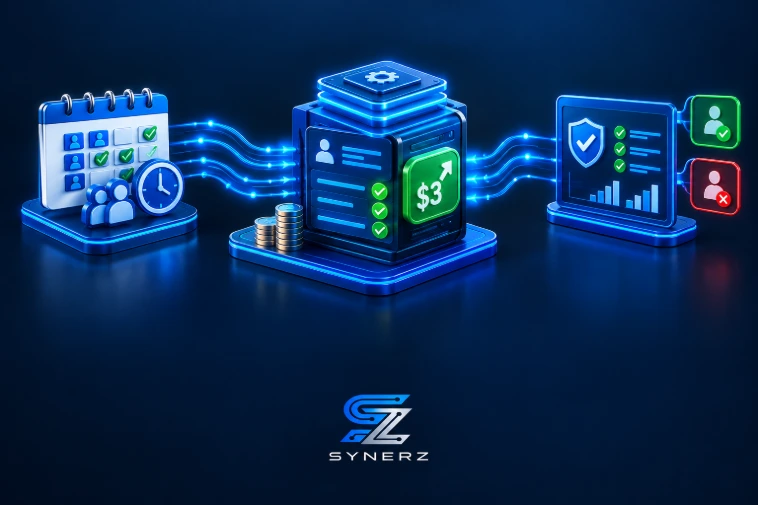
When a PSW is assigned a shift in the scheduling module, the system knows the shift type. When she completes the shift and submits her timesheet, the hours flow directly into payroll. There is no export. There is no manual reconciliation.
The system applies the PCE rules automatically. Direct client support hours get tagged for the $3 enhancement. Training hours, team meeting hours, and paid leave hours are tagged separately. Payroll applies the enhancement only to eligible hours.
CPP and EI calculations include the enhancement automatically because the system treats it as pensionable and insurable income. When the minimum wage changes on October 1, you update one base-rate parameter. Every linked calculation — enhancement, CPP, EI, net pay — recalculates.
Here is the before-and-after comparison.
Payroll Step | Manual Process (Typical Agency) | Connected System (Essential Staff Practice) |
Timesheet to payroll | Manual export/import | Automatic data flow |
PCE hour classification | Spreadsheet highlighting | Auto-tagged at source |
PCE calculation | Per-employee manual math | System-applied rule |
CPP/EI on enhancement | Often miscalculated | Automatic inclusion |
Minimum wage update | Person-by-person edits | One parameter update |
Audit trail | Spreadsheet with highlights | Tagged hours + system log |
Biweekly payroll total | 3+ hours | 18 minutes |
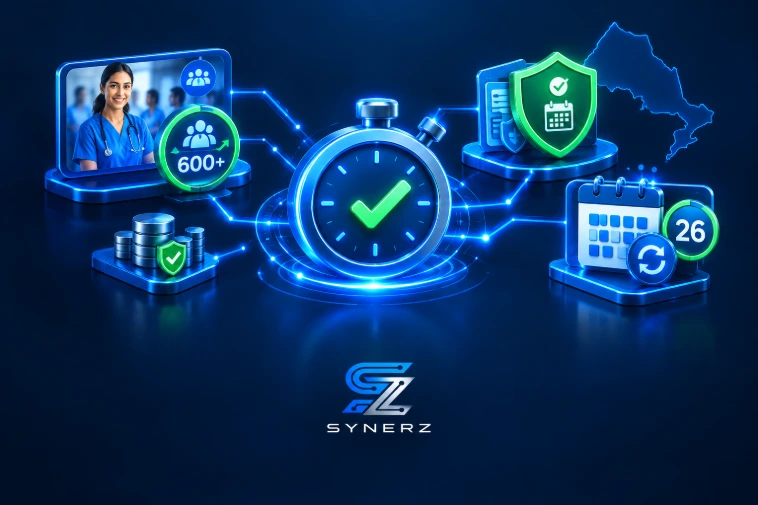
Essential Staff operates with 600+ PSWs in the recruitment database. When a credential expires, the system moves that applicant to an "Expired Documents" stage and removes them from the schedulable pool. When an open shift appears, the full roster is notified via email in under three minutes. The same system discipline applies to payroll: the data flows automatically, and the calculations are auditable.
Pipeline Breakdown: How the PCE Flows Through the System
The Staff Pipeline and the payroll process are not separate workflows. They are connected.
Step 1: Recruitment and onboarding. A PSW applies through the website. The application auto-lands in the Recruitment database. Credentials are verified: PSW Certificate, Police Vulnerable Sector Check, CPR & First Aid, TB Test, References. Only verified applicants move to the active pool.
Step 2: Scheduling. The PSW is assigned shifts in the Planning module. Each shift has a type: direct client care, training, team meeting, or administrative. The shift type determines PCE eligibility.
Step 3: Timesheet submission. The PSW completes the shift and submits her timesheet through the system. Hours are recorded against the shift type.
Step 4: Payroll calculation. The Payroll module pulls the approved timesheets. It applies the base rate, calculates the PCE enhancement for direct care hours only, includes the total in CPP and EI calculations, and generates the payslip.
Step 5: Compliance and reporting. Every payslip has an audit trail showing which hours received the enhancement. T4 certification data is available as a report. The system does not require a separate calculation for CRA compliance.
Step 6: Minimum wage updates. When the minimum wage changes, you update the base-rate parameter. All PSWs whose rate was tied to the floor are automatically flagged for adjustment. The PCE enhancement recalculates on the new base.
This is the Two-Pipeline System in action: the Staff Pipeline (recruitment to payroll) and the Client Pipeline (lead to invoice) converge at the connected operating core.
Real Results From a Live Ontario Agency
Essential Staff is a licensed PSW and healthcare staffing agency based in St. Thomas, Ontario. Our payroll data is the proof.
Biweekly payroll was cut from 3+ hours to 18 minutes. The PCE calculation is a significant part of that reduction. Before the connected system, we were reviewing timesheets manually, flagging direct care hours, and calculating the enhancement in a spreadsheet. Now the system tags hours at the source and calculates automatically.
26 payroll runs per year, zero CRA penalties over 3 years. The enhancement is included in CPP and EI calculations correctly because the system treats it as pensionable and insurable income. T4s are generated from the same data.
600+ PSWs in the recruitment database. When an applicant's credentials expire, the system moves them out of the active pool automatically. This is not a payroll feature, but it is the same data discipline: the system knows the status of every record, and it enforces the rules.
Credential alerts fire at 30, 14, and 7 days before expiry. PSW Certificate, Vulnerable Sector Check, CPR & First Aid, TB Test, References. Colour-coded compliance dashboard: green valid, yellow warning, red expired.
These numbers are not marketing claims. They are the output of a system that runs a live agency every day.
Step-by-Step: How to Get Started Today
You do not need a connected system to start improving your PCE payroll process. Here is what you can do today.
Audit your PCE eligibility rules. Confirm you are applying the $3 enhancement only to direct client care hours. Training, paid leave, and administration are excluded .
Review your CPP and EI calculations. Confirm the enhancement is included in gross earnings for deduction purposes. If it is added after deductions, you are under-remitting.
Pull a T4 certification sample. If you have PSWs claiming the 2026 tax credit, verify that your hours data can produce certified eligible hours.
Check your minimum wage exposure. Identify every PSW whose base rate is below $17.95. Confirm your October 1 adjustment plan.
Test your audit trail. If MCCSS asked you to prove which hours received the PCE and which did not, could you produce that record?
Calculate your manual payroll time. Time one full biweekly payroll run. If it takes more than an hour, you have a process problem worth solving.
Common Mistakes to Avoid
Mistake one: applying the PCE to all hours. The enhancement is for direct client care only. Training, paid leave, and administration do not qualify . If you are paying the enhancement on all hours, you are overpaying and creating a liability when MCCSS audits.
Mistake two: excluding the PCE from CPP/EI calculations. The enhancement is pensionable and insurable. It must be included in gross earnings before CPP and EI deductions.
Mistake three: using spreadsheets as the audit trail. MCCSS expects employers to monitor and evaluate PCE implementation . A spreadsheet with highlighted cells is not a system of record. A payroll system that tags hours at the source is.
Mistake four: ignoring wage compression when minimum wage rises. The October 1 increase to $17.95 creates compression between new and experienced PSWs. Adjust your wage bands proactively.
Mistake five: treating the PCE as temporary. MCCSS renewed the program for 2026-27. Build your payroll process around it as a permanent feature.
Mistake six: not connecting scheduling and payroll. If your scheduling system and payroll system do not talk to each other, you are creating manual work and error risk at every pay period.
Ready to Simplify Your PCE Payroll?
Book a free 20-minute payroll and compliance review. We review your current PCE calculation process, flag the compliance risks, and give you a clear picture of where your agency stands. No pitch. No obligation. Just clarity.
📧 info@synerz.ca | 📞 +1 647 493 8110 | 🌐 www.synerz.ca
Frequently Asked Questions
Is the $3/hour PSW wage enhancement still active for 2026-27?
Yes. MCCSS confirmed the Permanent Compensation Enhancement (PCE) for 2026-27 on May 5, 2026. The $3/hour top-up applies to eligible PSWs and DSWs providing direct client care .
Which PSW hours qualify for the $3/hour enhancement?
The enhancement applies to personal client care: feeding, dressing, personal hygiene, toileting, managing medication, and direct community participation support. Training, paid leave, and administration do not qualify .
How does the PCE affect CPP and EI deductions?
The PCE is pensionable and insurable income. It must be included in the employee's gross earnings for CPP and EI calculation. If your payroll system adds it after deductions, you are under-remitting.
What is the payroll setup for PCE in a PSW agency?
The system should tag direct care hours at the scheduling source, apply the $3 enhancement only to eligible hours, include the enhancement in CPP/EI calculations, and generate an audit trail showing which hours received the enhancement.
How do I calculate PCE with the new $17.95 minimum wage?
The enhancement applies on top of the base rate. A PSW at minimum wage earns $17.95 base plus $3 enhancement for eligible hours. If your base rate is higher, the enhancement still applies at $3/hour.
What records do I need for a PCE audit?
MCCSS expects employers to monitor PCE implementation. You need a record showing which hours were classified as direct care and received the enhancement. A payroll system that tags hours at the source provides a defensible audit trail.
Can I automate PCE calculation with Odoo 19?
Odoo 19 Enterprise supports automated payroll with CPP/CPP2, EI, and federal/provincial tax calculations. The system can tag hours and apply enhancement rules if configured correctly .
Author: Munawar Abbas — Founder & CEO, SYNERZ