If you run a PSW staffing agency in Canada, CRA payroll compliance is the one thing that can quietly sink your business while every shift looks like it is running fine. PSW payroll in Canada follows placement-agency rules that most owners never learn until it is too late. The placement-agency payroll rules are different from a normal employer's and most owners do not find that out until a reassessment letter arrives.
Here is the urgency. The CRA updated its "Payments to workers of placement and employment agencies" guidance on April 20, 2026, and worker-misclassification enforcement in healthcare staffing is active right now. If you have been paying PSWs as contractors to skip source deductions, you are exposed.
I have run payroll inside a licensed Ontario PSW agency for three years. In this guide I will show you exactly which CRA rules apply to a staffing agency, where owners get caught, and how we keep our agency at zero penalties.
What CRA Payroll Compliance Means for a PSW Staffing Agency
Let me start with the rule that catches the most owners, because a normal employer never has to think about it.
The CRA treats placement agency payroll under special rules that differ from a normal employer's obligations. For Canada Pension Plan and Employment Insurance purposes, a worker you place under a client's direction and control can count as your insurable, pensionable employment even if you think of them as a contractor as long as you pay them and earn a fee for placing them.
Read that again. "Read that again. The PSW employee vs contractor question does not work the way most owners think calling someone a "contractor" does not automatically get you off the hook for CPP and EI.
So you can end up in a situation most owners never see coming: a placed PSW is deemed insurable and pensionable, meaning your agency must deduct and remit CPP and EI, while income tax withholding follows the worker's actual employee status. That split is exactly where agencies trip they treat the whole relationship as "contractor," deduct nothing, and the CRA disagrees on the CPP/EI side.
Three years ago at Essential Staff, our exposure looked like a lot of small agencies' books today. PSW hours lived in a spreadsheet. Wage figures lived in a separate file. The actual remittance happened in a payroll portal that did not talk to either. Reconciling what we paid against our CRA source deductions was a manual job every single run.
We run biweekly payroll 26 runs a year across 187 PSW staff. When your source data sits in three disconnected places, one mistyped figure becomes a remittance that does not match your T4s. That mismatch is precisely what a payroll inspection by CRA looks for and a payroll inspection CRA triggers can go back four years of records..
And the penalties are not theoretical. Misclassify a worker and the CRA can reassess you retroactively for the full employer portion of CPP and EI, plus penalties and interest. Remit late and you face penalties that climb with how late you are. For a PSW staffing agency in Canada running thin margins on $30–$45/hour client rates, one reassessment can erase a year of profit.
This is the content gap nobody fills in plain English: what placement-agency CRA rules actually mean for a homecare or PSW staffing operator.
Why CRA Payroll Compliance Matters Right Now in 2026
The timing is what makes this urgent, not just important.
Worker misclassification CRA enforcement is live in healthcare staffing this year. The sector's heavy use of casual and contract labour has put it directly in the agency's sights, and the refreshed placement-agency guidance signals where attention is going.
On top of that, the new PSW Tax Credit 2026 a federal refundable credit now trending more than 1,050% in Canada adds an employer certification duty. Only properly classified employees with clean payroll records qualify. Misclassified PSWs lose the credit and flag your books at the same time.
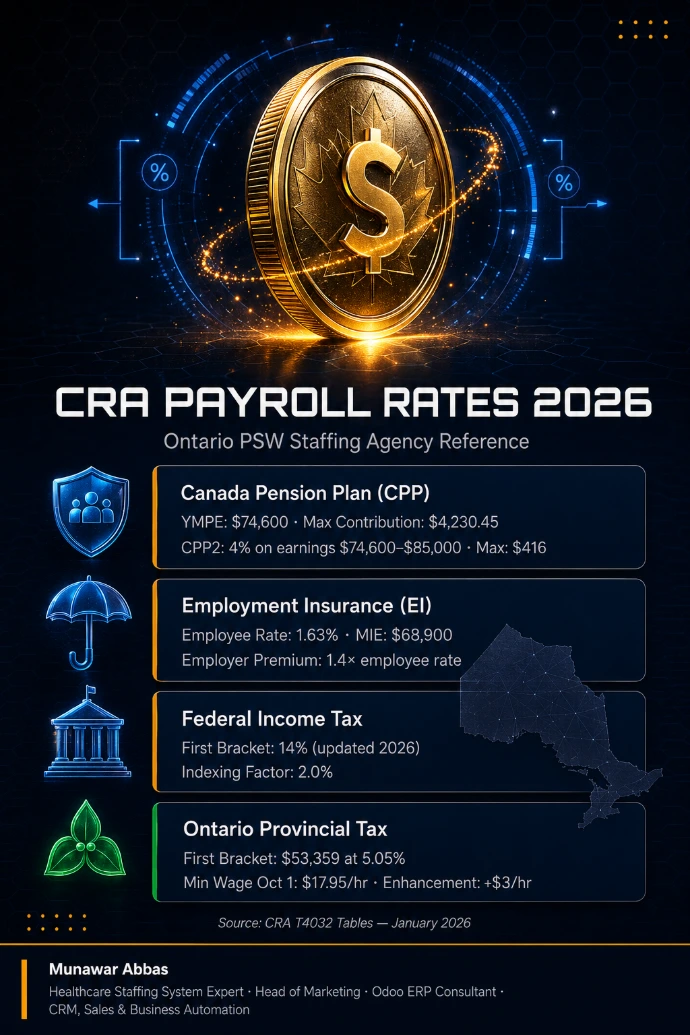
The numbers also moved this year. For 2026 the federal lowest tax bracket dropped to 14%, the CPP YMPE is $74,600 with the new CPP2 band charging 4% on earnings between $74,600 and $85,000, and the EI rate is 1.63% on insurable earnings up to a $68,900 maximum. Your employer EI is 1.4 times the employee premium. Miscalculate any of these across 187 staff and the gap compounds fast.
Add the operational pressure Ontario minimum wage rising to $17.95/hour on October 1, 2026, the paused Home Care Worker PR pilot tightening your labour pool and clean payroll stops being paperwork. It becomes the foundation everything else sits on.
How to Build CRA Payroll Compliance Into Your PSW Agency
So how do you actually get compliant without hiring a full payroll department? You stop running payroll across disconnected tools and put hours, classification, deductions, and remittance reporting inside one system that already knows every dollar you paid each PSW.
That is what we built at Essential Staff on Odoo 19 Enterprise. Odoo payroll in Canada handles CPP, CPP2, EI, and federal plus provincial tax natively and we now implement it for other agencies.. The win is not "features." It is that your remittance figures and your T4s are drawn from the same validated data so they cannot drift apart.
Here is the before-and-after, using our real numbers.
| Payroll task | Before (spreadsheets + portal) | After (Odoo 19 ERP) |
|---|---|---|
| Time per biweekly payroll run | 3+ hours | 18 minutes |
| CPP / CPP2 / EI / tax calculation | Manual lookup, error-prone | Auto-calculated every run |
| Source data → remittance match | Reconciled by hand, 3 sources | One source of truth |
| Worker classification record | Loose / inconsistent | Tagged per worker, audit-ready |
| CRA penalties in 3 years | Risk on every run | Zero |
| T4 / year-end reporting | Manual export and rebuild | Generated from live payroll |
Inside a PSW agency, the flow is simple. Approved timesheets feed payroll automatically. CPP, CPP2, EI, and federal plus Ontario income tax calculate on every run against the current 2026 figures the $74,600 YMPE, the 4% CPP2 band, the 1.63% EI rate, the 14% federal and 5.05% Ontario first brackets. Remittance reports come straight off that data, and T4s at year-end are a generated report, not a rebuild.
Classification lives in the system too. Each worker is tagged as employee or self-employed, so your T4 and T4A reporting is consistent and defensible if the CRA ever asks.
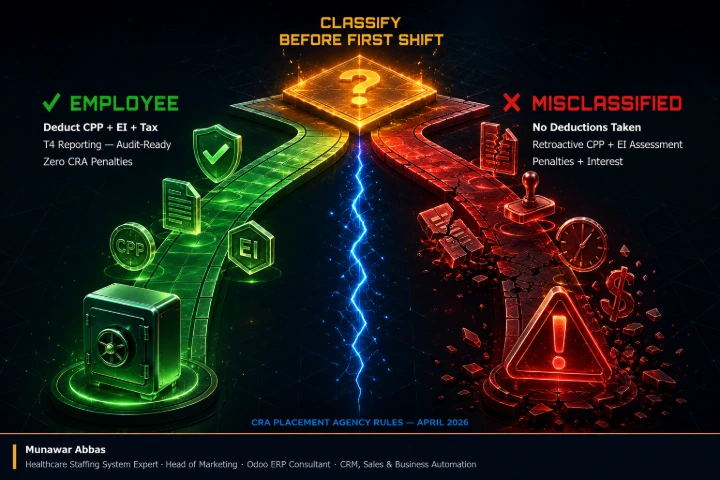
💡 Insider Tip: Decide each PSW's status before their first shift, not at tax time. If the worker performs care under your client's direction and you pay them, assume CPP and EI apply and confirm the specifics with the CRA or your accountant. Reversing a misclassification after a year of pay runs is far more expensive than getting it right on day one.
Compliance does not stop at deductions. We track 187 PSW credentials PSW Certificate, Police Vulnerable Sector Check, CPR & First Aid, TB Test, References on one colour-coded dashboard with automated alerts at 30, 14, and 7 days before expiry. Payroll compliance and credential compliance run on the same backbone.
Need help with CRA payroll compliance for your PSW staffing agency? See how SYNERZ builds this for Canadian PSW agencies → www.synerz.ca
Real Results From a Live Ontario Agency
I do not sell theory. Essential Staff is a licensed PSW agency in Ontario based in St. Thomas and I ran every system inside it for three years before packaging it for other operators..
Here is what the numbers look like in practice.
We took our biweekly payroll from 3+ hours down to 18 minutes. Across 26 runs a year, that is roughly 65 hours of admin reclaimed annually time that now goes into filling shifts instead of fixing spreadsheets.
In three years of operation, we have had zero CRA penalties. Not one source-deduction correction, not one remittance flag. When you run CRA-compliant payroll inside one system, the 90% remittance threshold and your deduction math stop being guesswork.
On the operations side, our open-shift alert system notifies all 187 PSWs in our applicant pool by email blast in under three minutes. Before, filling an overnight cancellation meant phoning down a list. Now the right qualified, credentialed staff hear about it instantly.
Our compliance dashboard is colour-coded green for valid, yellow for warning, red for expired so an audit-readiness check that used to take an afternoon now takes one glance. Applicants whose credentials lapse are auto-moved to an "Expired Documents" stage so they never get alerted for a shift they cannot legally take.
This is the proof a generic payroll vendor cannot show you. They were built for clinics and hospitals. We were built inside a working Ontario PSW agency, which is exactly why the PSW tax credit 2026 employer certification fits the system instead of breaking it.
Step-by-Step — How to Get Compliant Today
You can start tightening your compliance today, with or without us. Here is the order I would follow.
- Read the placement-agency rules. Pull up the CRA's "Payments to workers of placement and employment agencies" page and confirm how CPP, EI, and income tax apply to your specific setup.
- Audit every worker's classification. For each PSW, decide employee or self-employed based on direction, control, and how you pay them not on what is convenient at tax time.
- Reconcile remittances to T4s. Pull last year's remittances and compare them line-by-line to your T4 totals. Any gap is your risk.
- Verify your 2026 rates. Confirm CPP YMPE ($74,600), CPP2 (4% on $74,600–$85,000), EI (1.63%, max $68,900), and the 14% federal / 5.05% Ontario first brackets are loaded correctly.
- Consolidate to one source of truth. Whatever system you use, hours, classification, deductions, and reporting must live in one place.
- Confirm with a professional. Before filing season, have your accountant review your classification calls and remittance history.
Common CRA Payroll Compliance Mistakes Agencies Make
I see the same avoidable errors across agencies. Do not repeat them.
Mistake 1: Assuming "contractor" ends your CPP/EI duty. Under placement-agency rules, a PSW working under a client's direction can be your insurable, pensionable employment regardless of the label. The label does not protect you.
Mistake 2: Letting source data and remittances drift. When hours, pay, and remittance live in three systems, your T4s and your remittances stop matching and that gap is the first thing a CRA inspection finds.
Mistake 3: Deciding classification at tax time. By then you cannot cleanly undo a year of mis-paid runs. Classify before the first shift.
Mistake 4: Remitting late. Remittance penalties climb with how late you are, and chronic lateness invites a closer look. Automate the schedule so it never slips.
Book a Free 20-Minute Compliance Check
You do not have to figure the PSW tax credit 2026 employer certification out alone. Book a free 20-minute compliance check and we will review your current payroll and credential setup and give you a clear picture of where your agency actually stands going into certification season. No pitch. No obligation. Just clarity from a fellow Ontario operator who has already done it.
📧 info@synerz.ca 📞 +1 647 493 8110 🌐 www.synerz.ca
This article is general information for agency owners, not tax or legal advice. Confirm credit figures and certification requirements with the CRA and your accountant.
Frequently Asked Questions
What payroll system do healthcare agencies use?
Many small PSW agencies still run on spreadsheets plus a basic payroll portal, which struggles with worker classification, credential tracking, and CRA reporting. Agencies serious about compliance move to an integrated ERP like Odoo 19, where hours, deductions, remittances, and T4s all draw from one validated source.
What happens in a payroll inspection with CRA?
The CRA reviews whether your source deductions, remittances, worker classifications, and T4 filings all match each other and your records. Clean, single-source payroll data is the difference between a quick review and a retroactive reassessment with penalties and interest.
What qualifies a person as an independent contractor in Canada?
The CRA weighs factors like control over the work, ownership of tools, chance of profit or risk of loss, and how integrated the worker is into your business. For PSW staffing agencies, placement-agency rules add a wrinkle: a worker can still be insurable and pensionable for CPP and EI even when treated as a contractor, so confirm each case.
Can a PSW work as self-employed in Canada?
A PSW can be self-employed in some arrangements, but if your agency places them under a client's direction and pays them, the CRA may treat that employment as pensionable and insurable on your books. Get the classification confirmed before you pay them, not after.
Is Odoo used in Canada?
Yes. Odoo is used by Canadian businesses across many sectors, and Odoo 19 Enterprise supports CRA-compliant payroll, including CPP, CPP2, EI, and federal and provincial income tax calculations. We run a live PSW agency on it in Ontario.
Author voice: Munawar Abbas - Founder & CEO, SYNERZ